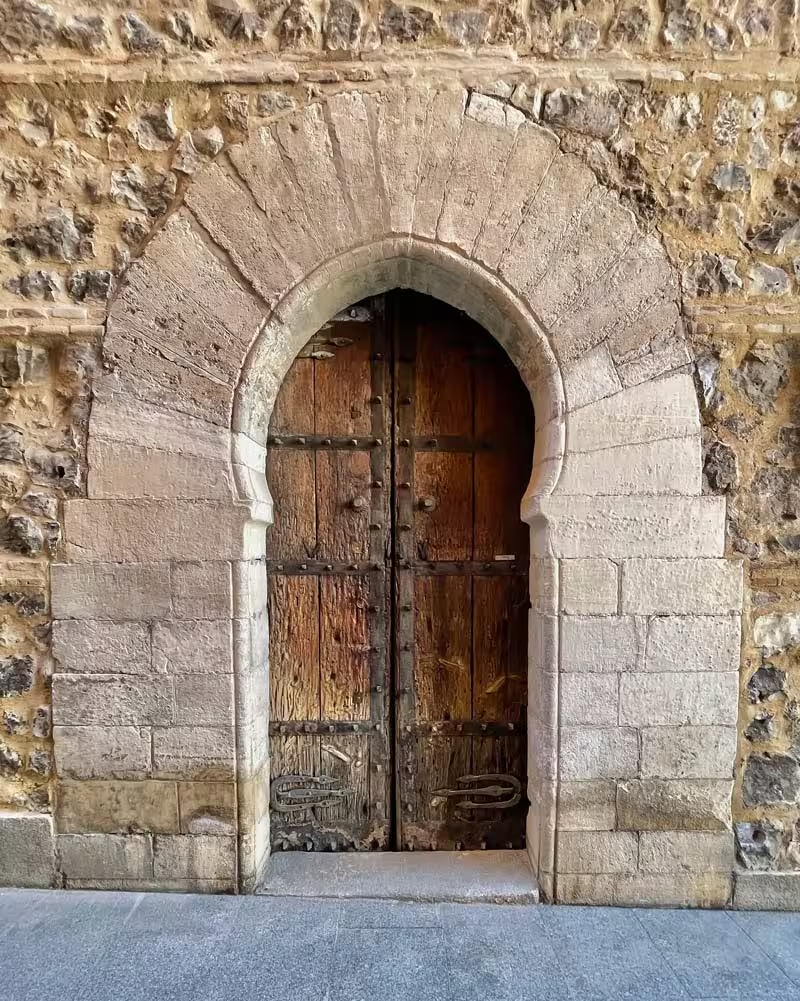
At the beginning of Calle del Codo, in the heart of the Austrias district and adjacent to Plaza de la Villa, stands the door of the Torre de los Lujanes (Lujanes Tower). Framed by a horseshoe arch with stone voussoirs that still bear visible quarry marks, this door has traditionally been held to be the oldest in Madrid. Now, a study commissioned by the Real Sociedad Económica Matritense de Amigos del País (RSEMAP) has allowed us to clarify the veracity of this claim.
A Study to Discover its Age
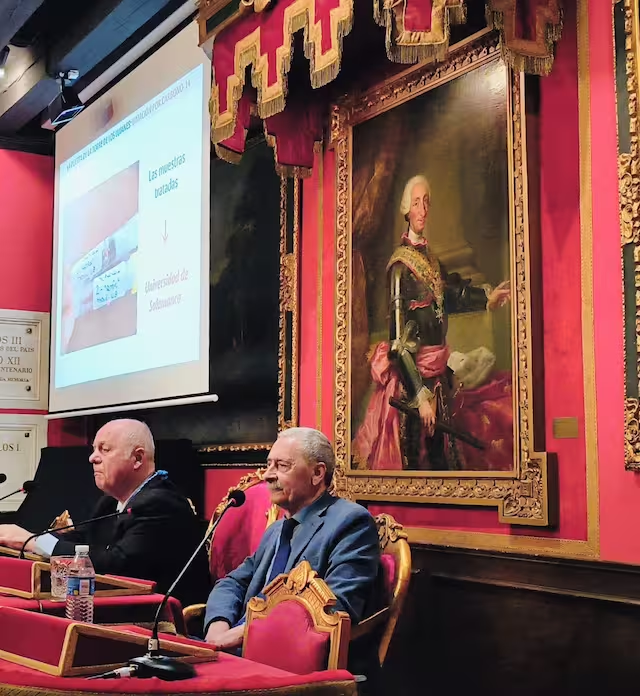
Since 1867, this door has provided access to the headquarters of the Real Sociedad Económica Matritense de Amigos del País (RSEMAP), and it is this very institution—which celebrates its 250th anniversary this year—that commissioned a scientific analysis to determine its exact age. The study, carried out by the Laboratory of Ionizing Radiation and Dating of the Department of Fundamental Physics at the University of Salamanca, was made public this Tuesday, November 24th, at an event held at the RSEMAP headquarters. The conclusions indicate that the wood used in the door comes from a tree that was alive around the year 1415, with a margin of error of $\pm 10$ years, which places the door’s construction around 1420. At that time, the building did not belong to the Lujanes lineage, but to its previous occupants, the Ocaña family (more information in “Las casas de los Lujanes: Noticias sobre sus primeros ocupantes”).
One of the coordinators and promoters of this study was our colleague José Manuel Castellanos, a renowned historian of medieval Madrid and also a member of the RSEMAP.
Since 1867, this door has provided access to the headquarters of the Real Sociedad Económica Matritense de Amigos del País (RSEMAP), and it is this very institution—which celebrates its 250th anniversary this year—that commissioned a scientific analysis to determine its exact age. The study, carried out by the Laboratory of Ionizing Radiation and Dating of the Department of Fundamental Physics at the University of Salamanca, was made public this Tuesday, November 24th, at an event held at the RSEMAP headquarters. The conclusions indicate that the wood used in the door comes from a tree that was alive around the year 1415, with a margin of error of $\pm 10$ years, which places the door’s construction around 1420. At that time, the building did not belong to the Lujanes lineage, but to its previous occupants, the Ocaña family (more information in “Las casas de los Lujanes: Noticias sobre sus primeros ocupantes“).
One of the coordinators and promoters of this study was our colleague José Manuel Castellanos, a renowned historian of medieval Madrid and also a member of the RSEMAP.
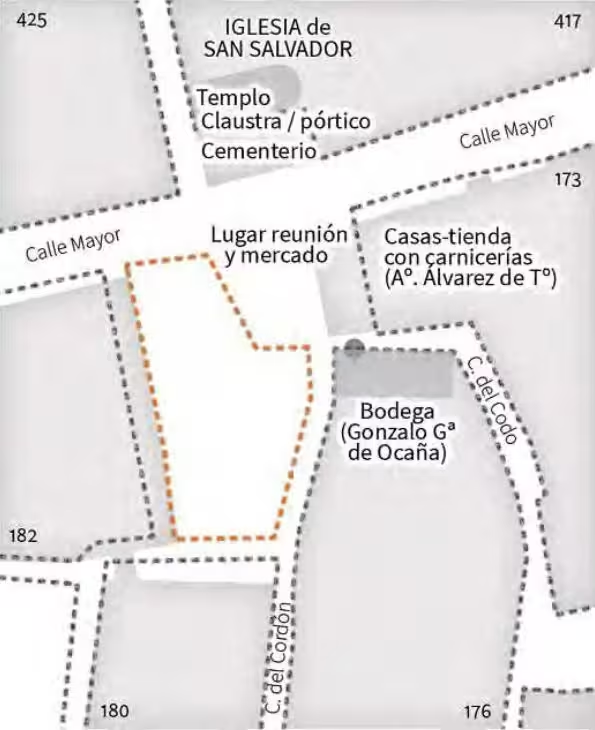
One of the hypotheses proposed by Castellanos is that this door may have provided access to the cellar of Gonzalo García de Ocaña, as can be seen in the attached image, which shows the surroundings of the old Plaza de San Salvador in the mid-15th century, where today the Plaza de la Villa is located. In block 176 stood, until 1450, the houses of the accountant Gonzalo García de Ocaña, which from that date passed into the hands of the royal chamberlain Pedro de Luján.
A medieval treasure in the heart of Madrid
This discovery not only confirms the exceptional antiquity of this door, but also reinforces the heritage value of a corner that, despite its discreet appearance, holds centuries of history. Its current condition, marked by the passage of time and the lack of proper interventions, deserves careful and rigorous restoration. We trust that the competent authorities will recognize the historical value of this unique element and grant it both the protection and the attention that its status as a living testimony of medieval Madrid demands.

- The Ancient Door of the Lujanes Tower: Scientific Study Confirms its Age - 1 December, 2025
- La Musica notturna delle strade di Madrid - 1 October, 2024